
Once again, the Federal Government is proposing major changes to the SR&ED program. Budget 2026, tabled on November 5, proposes a further expansion of the program that is expected to provide $930M in additional support over five years.
This latest announcement builds on the previous round of SR&ED reforms, which were first proposed in Budget 2024 and came into effect in April 2026. These changes expanded access to the enhanced investment tax credit (ITC) and reinstated eligibility for capital expenditures.
If implemented, the latest proposals would represent a broader approach to supporting innovation in Canada. Rather than focusing primarily on the R&D needed to develop new technologies, the government is looking to extend support further along the commercialization journey. After all, developing a new technology is only part of the process. Businesses also need to test, validate, protect and ultimately bring those innovations to market.
It is important to note that these are proposed changes, not yet enacted into legislation. Although the federal government has provided some detail on what could qualify, we’ll need to wait for the final legislation and CRA guidance to understand exactly how the new rules will work.
Interestingly, Quebec has already introduced a similar approach through its Tax Credit for Research, Innovation and Commercialization (CRIC). The provincial program recognizes certain activities that take place between R&D and commercialization. However, the CRIC in Quebec and the proposed changes to the federal program are not identical.
Below we’ll breakdown what is being proposed federally, how it compares to Quebec’s CRIC, and what these changes could mean for businesses already claiming or considering SR&ED.
What is Budget 2026 Proposing for SR&ED?
Historically, the SR&ED program has focused on three types of work: basic research, applied research and experimental development. Under the existing rules, activities undertaken beyond experimental development stage are generally no longer eligible.
However, developing a new technology is only one part of the innovation process. Once the technological challenges have been resolved, businesses often still need to complete additional work before bringing a product or process to market. This can include regulatory testing, obtaining certifications and securing intellectual property protection.
The proposed Budget 2026 changes recognize some of these activities as part of the broader innovation journey.
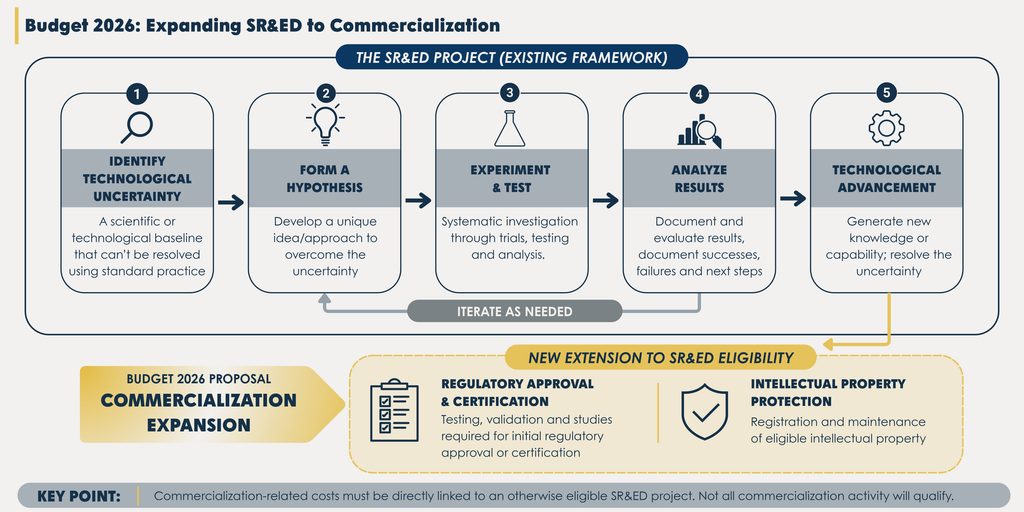
Specifically, the federal government is proposing to expand eligible SR&ED expenditures to include two additional categories:
Regulatory approvals and certifications
This relates to the costs of obtaining initial regulatory approval or certification needed to bring a product or process to market. This could include:
- Regulatory testing
- Technological validation
- Studies required to meet regulatory requirements
For example, a company developing a new medical device may successfully resolve the technological challenges associated with its design but still need to complete additional testing and validation to meet regulatory before it can be sold.
Under the current SR&ED framework, this type of work would generally fall outside of the scope of eligible activities once the technological uncertainty has been resolved. Under the proposed changes, certain costs associated with obtaining that initial approval or certification could become eligible.
Theses regulatory activities must directly relate to a project that would otherwise qualify for SR&ED under the existing rules. In other words, the proposal does not make regulatory testing independently eligible for SR&ED. The underlying project must still meet the existing requirements for basic research, applied research or experimental development.
The types of expenditures that could be claimed would follow the existing SR&ED expenditure categories (wages & salaries, materials, contract costs, overhead costs, capital costs and lease costs).
Intellectual Property Protection
This relates to the costs of securing and maintaining intellectual property (IP) protection developed through an eligible SR&ED project.
Eligible expenses could include the costs of preparing and filing applications for IP protection, administration and registration fees payable to IP offices, as well as periodic maintenance fees required to keep those rights in force.
However, not all IP-related expenses would qualify. For example, costs associated with enforcing IP rights, including litigation relating to alleged infringement, would be excluded.
There are also important geographical considerations when determining which expenses could qualify. Administration fees payable to an IP office outside Canada would be eligible under the proposal. However, the supporting activities associated with obtaining IP protection would only be eligible if those activities are conducted in Canada. The distinction is particularly important for businesses working with foreign patent agents, lawyers or other IP professionals. While fees payable to a foreign IP office could qualify, professional fees for supporting work performed outside Canada would not.
When Would These Changes Take Effect?
This measure, when enacted, would apply to expenditures incurred in taxation years that begin on or after Budget Day (November 5, 2026).
While we’ll need to wait for the legislation to be finalized before businesses can formally claim these expenses, there are steps companies can take now to prepare.
Businesses should start reviewing their upcoming regulatory testing, certification and IP-related costs against the proposed eligibility criteria. This includes identifying potentially eligible activities, tracking associated expenditures and retaining supporting documentation, such as invoices, contractor agreements and records of the work performed.
Getting ahead of this now could make it easier to incorporate these expenses into future SR&ED claims once the changes are enacted. It may also help businesses identify whether expenditures incurred in an earlier taxation year could be eligible for an amended claim, subject to the final legislation and applicable CRA filing deadlines.
Quebec’s CRIC: A Similar Approach to Supporting Commercialization
Quebec has already taken steps to extend tax incentives beyond traditional R&D activities trough its Tax Credit for Research, Innovation and Commercialization (CRIC), introduced for taxation years beginning after March 25, 2025.
Unlike the existing federal SR&ED program, CRIC supports certain pre-commercialization activities connected to eligible R&D. Specifically, Quebec’s program covers two additional areas:
Regulatory testing and validation: Tests, technological validations and studies required to obtain initial regulatory approvals or certifications
Product design: Activities involving product form, aesthetics, functionality and material selection
To be eligible, activities must be tied to eligible R&D or pre-commercialization activities and be incurred in the province of Quebec.
The proposed federal expansion takes a somewhat different approach. While both programs recognize regulatory testing and validation, the federal proposal also specifically includes certain costs associated with securing and maintaining IP. However, unlike CRIC, it does not include product design as an additional eligible activity.
What Does This Mean for You?
The two programs demonstrate a broader approach to supporting innovation: recognizing that developing a new technology is only one part of bringing it to market. While we wait for the legislation to be finalized, businesses should start identifying and tracking their regulatory testing, certification and IP-related expenses. Maintaining supporting documentation now could make it easier to incorporate these costs into future SR&ED claims once the changes take effect.
At North Group, we will continue monitoring developments and helping businesses understand how changes to government tax incentives and funding programs could support innovation. In the meantime, understanding existing SR&ED eligibility and Quebec’s CRIC may help businesses identify opportunities to finance R&D and the activities that follow.
Interested in what else Budget 2026 has in store for Canadian businesses? Read our Budget 2026: Building Canada’s Next Generation of Businesses article for a breakdown of the other major funding announcements, investment incentives and business support measures.