
What 2025 Scale AI Funding Data Really Tells Us
Scale AI recently announced a record-breaking funding round of nearly $129M, outlining the projects supported in 2025 and reinforcing just how competitive Canada’s AI funding landscape has become. As artificial intelligence continues to move from experimentation to core business infrastructure, more organizations across healthcare, retail, manufacturing, and supply chains are turning to Scale AI for support.
But as interest grows, so does competition. A closer look at the 2025 project data reveals clear patterns in who gets funded, where projects are delivered, and how much of each project Scale AI is willing to cover.
What Is Scale AI and Why Demand Is Rising
Scale AI is Canada’s Global Innovation Cluster for AI-powered supply chains, designed to accelerate the adoption of artificial intelligence through large, collaborative industry projects. The program supports real-world AI deployment by funding a portion of eligible project costs while bringing together enterprises, SMEs, research institutions, and AI specialists.
As AI adoption accelerates, Scale AI has become one of the most sought-after programs in the country. The result: strong projects alone are no longer enough; understanding the program’s structural dynamics matters more than ever.
Quebec Anchors the Majority of Funded Projects
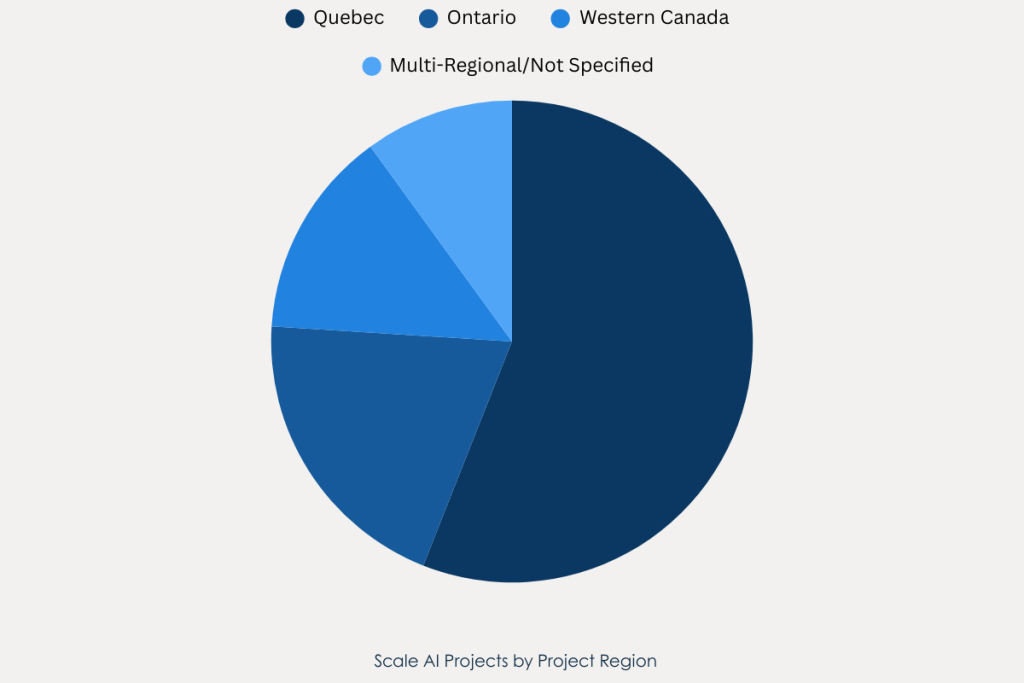
Based on an analysis of ~50 projects announced for 2025, Quebec remains the dominant project region under Scale AI.
- The majority of projects are officially delivered in Quebec
- Ontario follows at a distant second
- Western Canada (AB, BC, MB) accounts for a much smaller share of projects
This remains true even when consortia include national or international partners. In practice, projects with a Quebec delivery footprint are far more common, and more successful, than those led elsewhere.
This Concentration Is Not a Coincidence. Scale AI is headquartered in Montreal and operates within Quebec’s dense AI ecosystem. While the cluster is federally funded, it also receives provincial support ($1.4M from the Quebec government out of $7.9M in total funding in FY2024–2025), though the majority of funding coming from Innovation, Science and Economic Development Canada (ISED).
This structure naturally favors:
- Quebec-based delivery partners
- Quebec public institutions (especially hospitals)
- AI integrators embedded in the provincial ecosystem
The result is a funding environment where Quebec acts as the gravitational center of the program, even when projects have national impact.
Sector Trends in 2025
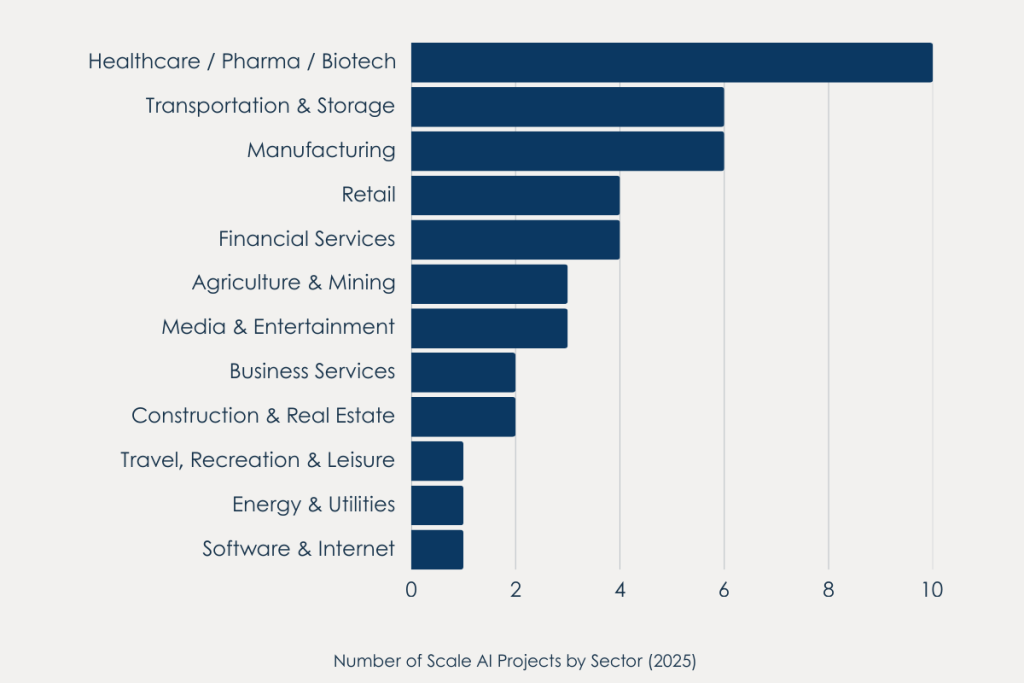
- Healthcare, Pharma & Biotech: The most heavily funded sector by project count and funding intensity, largely centered in Quebec health networks.
- Transport, Supply Chain & Manufacturing: Core to Scale AI’s mandate, with consistent 30–40% funding across mid- to large-scale projects.
- Retail & Consumer: Often anchored in Quebec even when retailers operate nationally.
- Financial Services: More Ontario-centric, with stable funding levels in the 40–50% range.
The Strategic Advantage of Quebec-Based Partners
Across the dataset, a small group of Quebec-based AI integrators and research organizations appear repeatedly in funded projects.
Notable examples include:
- IVADO Labs (8 projects)
- Vooban (4 projects)
- Moov AI (3 projects)
- Airudi (3 projects)
- Nexapp (2 projects)
- CRIM (2 projects)
Collectively, these organizations appear in a meaningful share of funded projects, suggesting that Scale AI funding decisions strongly favour experienced Quebec-based AI partners with a proven ability to deliver at scale. For companies outside Quebec, partnering with one of these organizations often serves as a gateway into the Scale AI ecosystem.
What This Means for Companies Seeking Funding
The 2025 data sends a clear message:
If you want to improve your odds of securing Scale AI funding, your project should be anchored in Quebec and led or co-led by a Quebec-based AI partner.
This doesn’t mean companies outside Quebec can’t succeed. It does mean that strategy matters: geography, consortium design, and partner selection are just as important as the AI use case itself.
Final Takeaway
Scale AI remains one of Canada’s most powerful levers for accelerating applied AI but it is not a neutral playing field. The 2025 funding data shows a clear, repeatable pattern: Quebec-anchored projects win more often, and often receive higher funding percentages.
For organizations planning to apply in 2026 and beyond, the lesson is simple: build your AI project where the ecosystem already works in your favor.