
Over the past few months, tariff relief has dominated many of our funding conversations. With businesses navigating increased costs, supply chain uncertainty and pressure on margins, finding ways to offset the impact of tariffs has understandably been a priority.
But AI is moving back into the spotlight.
Last month brough two developments for Canadian Businesses; The Regional Artificial Intelligence Initiative (RAII) reopened for applications across a few Regional Development Agencies, and Mitacs announced its AI Advantage program. Alongside these initiatives, BDC offers LIFT, a financing and advisory program designed to help businesses invest in AI and advanced technologies.
These announcements come as the federal government advances its national AI strategy, AI for All, which aims to accelerate AI adoption, develop Canadian talent and strengthen the country’s competitiveness.
For businesses considering how AI could improve productivity, modernize operations or support growth, now is a good time to revisit the funding landscape.
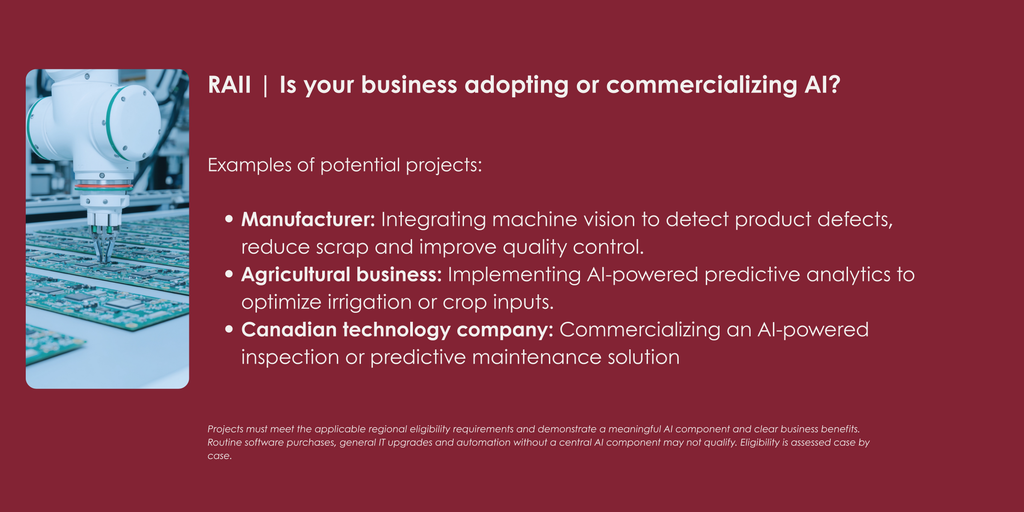
1. RAII: Funding for AI Adoption and Commercialization
The Regional Artificial Intelligence Initiative (RAII) is a federal program delivered through Canada’s regional development agencies. With an additional $500 million committed over five years, bringing the total investment to $700 million, the initiative supports businesses adopting AI, Canadian companies commercializing AI technologies, and organizations strengthening the ecosystem that enables AI adoption.
For businesses, the opportunity extends beyond developing AI technology from scratch. Projects that integrate AI into existing operations may also be eligible, provided they meet the applicable regional program requirements.
RAII application windows are opening across Canada
Several regional development agencies are currently accepting applications, but deadlines and intake conditions vary by region.
| Regional development agency | Application deadline or intake status |
| PacifiCan — British Columbia | November 23, 2026 |
| PrairiesCan — Alberta, Saskatchewan and Manitoba | Continuous intake until December 31, 2030, or until funding is fully committed |
| FedDev Ontario — Southern Ontario | November 24, 2026, for projects starting before March 31, 2027; January 19, 2027 for projects starting in 2027 |
| FedNor — Northern Ontario | Continuous intake until December 31, 2030, or until funding is fully committed |
| Quebec — CED | Continuous intake until December 31, 2030, or until funding is fully committed |
| ACOA — Atlantic Canada | November 20, 2026 |
| CanNor — Northern Canada | Accepting applications for projects starting before March 31, 2027 |
What businesses should know: An open intake does not guarantee funding. Eligibility, project start dates, available funding and application requirements differ by region. Businesses should confirm the current guidelines within their region before committing to project expenditures.
With some deadlines falling in November, businesses considering an AI project should assess their eligibility and readiness sooner rather than later.
Learn more: Regional Artificial Intelligence Initiative — Government of Canada
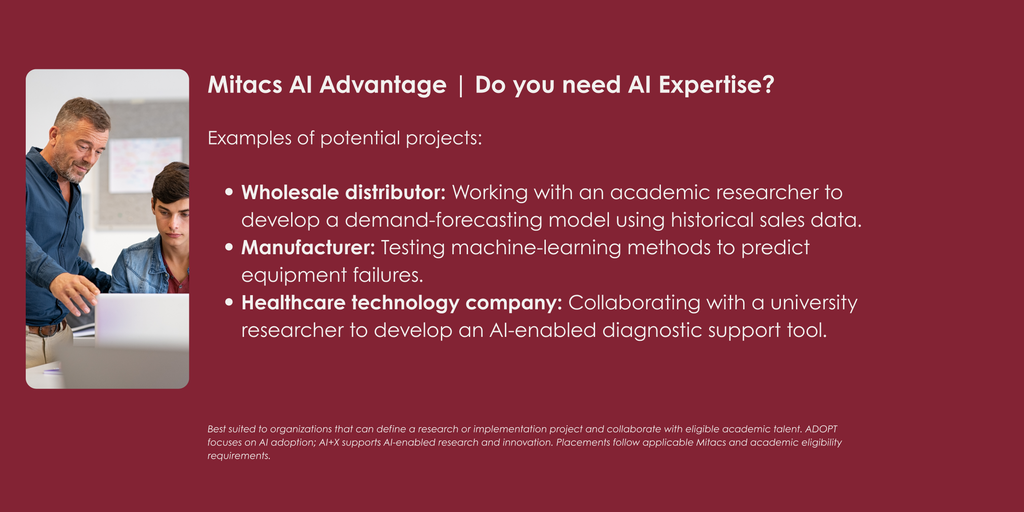
2. Mitacs AI Advantage: Access to Talent and Expertise
Not every business is ready to invest in a large-scale AI implementation. Sometimes the first challenge is determining where AI could deliver value, finding the right expertise or testing a potential solution.
That’s where Mitacs AI Advantage may be a good fit.
Announced in September 2026, the initiative is backed by up to $162 million in federal funding over five years to support 10,000 co-funded work placements connecting Canadian businesses with post-secondary students, recent graduates and postdoctoral fellows.
The program is designed to help businesses access specialized talent while advancing AI adoption and innovation.
Mitacs AI Advantage has two streams:
ADOPT — AI adoption
Supports work placements focused on testing and deploying AI solutions within businesses. This can help companies explore practical applications, improve internal processes and build their capacity to implement AI.
AI+X — AI innovation
Supports AI-enabled research and innovation that combines AI expertise with other disciplines to address business, scientific or technological challenges.
What businesses should know: Mitacs AI Advantage is particularly relevant when a company has a defined problem to solve but lacks the specialized expertise or internal capacity to move forward. It offers a way to bring talent into the business to investigate, test or advance an AI project.
Learn more: Mitacs AI Advantage
3. BDC LIFT: Financing for AI and Advanced Technology Investments
For businesses ready to invest in technology, BDC’s LIFT program offers another route to explore.
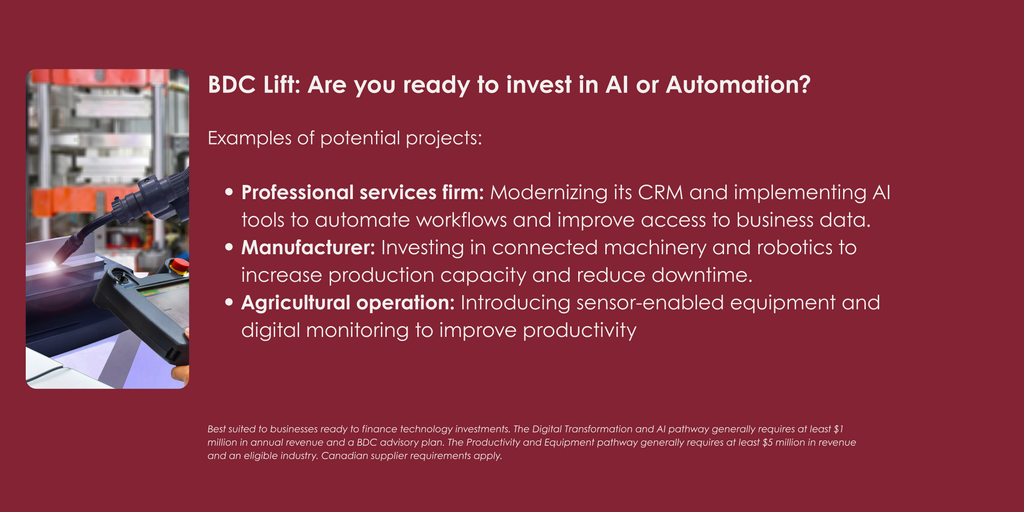
LIFT combines advisory services and financing to help Canadian businesses adopt AI, strengthen digital capabilities and invest in advanced technologies that improve productivity.
The program has two pathways:
Digital transformation and AI
Helps businesses plan and implement investments in AI, data, enterprise systems and cybersecurity. A BDC advisory plan is required for this pathway.
Productivity and digitally enabled equipment
Supports investments in equipment, robotics, automation and other digitally enabled technologies that improve productivity. Eligibility is limited to specified industries.
What businesses should know: The Digital Transformation and AI pathway generally requires at least $1 million in annual revenue and a BDC advisory plan. The Productivity and Equipment pathway generally requires at least $5 million in annual revenue and an eligible industry. Canadian supplier requirements also apply.
Unlike a grant, LIFT provides financing, so businesses should assess repayment obligations and the expected return on their investment.
Learn more: BDC LIFT — Lead with Innovation and Focus on Technology
Which Program Is the Right Fit?
These programs address different needs, and the best starting point depends on where your business is in its AI journey.
| If your business wants to… | Program to explore |
| Adopt AI or commercialize an AI solution through an eligible project | RAII |
| Access specialized talent to research, test or implement AI | Mitacs AI Advantage |
| Finance an AI, digital transformation or advanced technology investment | BDC LIFT |
The programs should not be assumed to cover the same costs or be interchangeable. If you are considering multiple sources of support, confirm the applicable eligibility and government assistance stacking rules before proceeding.
Where Does SR&ED Fit Into AI Implementation?
Government funding isn’t the only potential source of support for AI projects. In some circumstances, businesses may also be able to leverage SR&ED tax credits to support AI-related research and development.
However, implementing AI does not automatically make a project eligible for SR&ED. As with any SR&ED claim, businesses must demonstrate a meaningful technological advancement over existing knowledge or capabilities, and that achieving the advancement involved technological uncertainty and systematic investigation or experimentation.
As AI adoption becomes more widespread, the novelty of many applications is declining. Integrating an existing AI tool into a business process, configuring an off-the-shelf solution or automating a routine task will not, on its own, establish SR&ED eligibility. The key question is whether the project involves genuine technological challenges that require investigation to overcome, rather than simply applying existing technology.
We’ll be exploring this topic in more detail in an upcoming series on SR&ED and AI, including where the boundaries of eligibility lie and what businesses should consider when documenting AI-related projects.
In the meantime, don’t assume that an AI project automatically qualifies or rule it out simply because it uses existing AI tools. Each project needs to be assessed on its own facts and technical merits.
What Does This Mean for Your Business?
The return of AI funding is a reminder that funding opportunities should be considered alongside business strategy, not just when a program is announced.
You don’t necessarily need to have an AI product in development or a fully defined implementation plan today. But you should be able to identify a business challenge or opportunity that AI could help address.
Consider asking your team:
- Where are we losing time or productivity? Think about repetitive processes, manual data entry, quality control, forecasting and administrative tasks.
- Where could better data or automation improve decision-making? Consider inventory management, production planning, customer service and supply chain operations.
- Are we developing new products or technologies? AI may be relevant to product development, process innovation or commercialization.
- Do we have the internal expertise to move forward? If not, a research collaboration or access to specialized talent could be a useful starting point.
- Are we ready to implement a solution? If the project requires a significant investment, consider the financing, resources and expertise needed to move from testing to implementation.
The strongest funding strategy starts with a genuine business need, followed by an assessment of the available programs, not the other way around.
Don’t Let Funding Opportunities Pass You By
We’ve spent much of the last few months helping businesses navigate tariff relief. That work remains important, but it shouldn’t mean putting other funding opportunities on hold.
Canada’s national AI strategy signals a continued focus on helping businesses adopt AI, improve productivity and commercialize new technologies. With RAII, Mitacs AI Advantage, BDC LIFT and potentially SR&ED tax credits addressing different aspects of AI-related investment and development, businesses have several avenues worth exploring.
At North Group, we help businesses connect their growth and innovation priorities with the funding opportunities available to them. If you’re considering an AI project, or aren’t sure where AI could create value in your business, now is a good time to start the conversation.